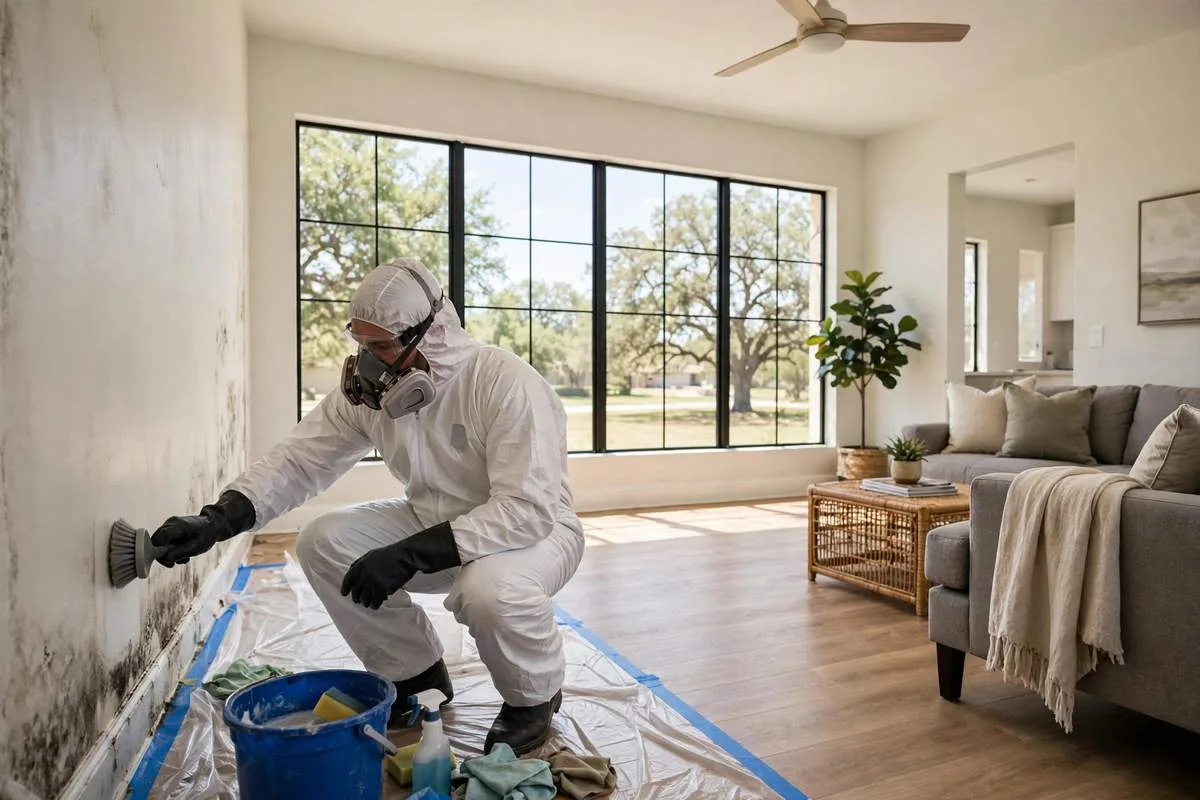
Los Angeles homes grow mold for local reasons. Older plaster and drywall over wood framing, slow plumbing leaks behind walls, roof leaks after winter rain, slab leaks in post-war homes, poor bathroom ventilation in older rentals, and coastal damp on the Westside all feed it. A provider who works in Los Angeles every week knows these patterns. Use the request form or call to describe what you have found, where it is, and whether there is an active leak, and a local provider will contact you to discuss the next step.
Why Los Angeles homes get mold
Los Angeles is dry for much of the year, which surprises people who find mold in their homes. Mold does not need rain falling on the roof. It needs moisture held in one place for long enough, and Los Angeles homes supply that in several quiet ways. A pinhole leak in a copper supply line can wet the inside of a wall for months before a stain appears. A shower with no working exhaust fan can keep a bathroom damp for hours every day. A roof that looks fine from the street can let winter rain into an attic, where it sits in insulation and on the underside of the roof deck.
The age of the housing stock matters. Much of Los Angeles was built before 1978, and many homes still carry their original plumbing, plaster and ventilation. Raised-foundation homes have crawl spaces that trap damp air, hillside homes deal with drainage and slope water, and coastal homes deal with marine-layer humidity. The moisture source has to be found and fixed, not just the visible growth wiped away.
- Slow plumbing leaks behind walls and under sinks
- Roof leaks after winter rain, especially on flat roofs
- Slab leaks in post-war single-family homes
- Bathroom and kitchen ventilation that never worked well
- Coastal humidity on the Westside and in the Harbor area
- Crawl space damp in raised-foundation homes
How the referral works
Requesting help through this site takes a few minutes. You describe the problem in the request form or on a call: where the mold is, how large the area looks, whether there is a leak or a musty smell, and whether anyone in the household has a reason the work needs to be handled carefully, such as a home sale or a tenant dispute. That information goes to an independent local provider in the referral network, who contacts you directly to discuss the job.
The provider then decides the next step with you, usually an inspection, a test, or a scope of work. The provider performs the work, not this site, and you deal with the provider on scheduling, pricing and the details of the job. If the job needs independent clearance testing after remediation, that is arranged with a separate provider.
- Describe the problem through the request form or by calling
- An independent local provider contacts you directly
- The provider inspects, tests or scopes the work as needed
- The provider performs the agreed work and discusses pricing with you
- Independent clearance testing can be arranged separately after remediation
One provider should not do everything
The most important thing to understand about mold work is the conflict of interest. A company that finds the mold, sells the cleanup, and then certifies its own cleanup has no independent check on its work. The IICRC S520 standard, the industry standard for professional mold remediation, treats inspection, remediation and clearance as separate functions for exactly this reason.
The referral model exists to make that separation practical. Inspection and testing can come from one independent provider, remediation from another, and post-remediation verification from a third. California has no law that forces this separation the way some other states do, so it is a matter of choosing the arrangement, not of following a statute. Every service page explains which part of the process it covers.
- Inspection and testing identify the problem and its cause
- Remediation removes the affected materials and dries the area
- Clearance testing verifies the work independently afterwards
- Separate providers mean each step is checked by someone else
Services available through the referral network
The network covers the full sequence of mold work, from the first look to the final verification. Inspection and assessment come first when the source of the moisture is unclear. Testing adds air or surface sampling and laboratory analysis when the type or extent of the growth needs documenting. Remediation is the contained removal of affected materials, cleaning of what can be saved, and drying of the structure, and post-remediation verification closes the job with independent clearance testing.
Room and property-specific help is available too: attic and crawl space work, bathroom mold removal, black mold remediation, water-damage mold cleanup, emergency help after a burst pipe or flood, and commercial remediation for offices, retail and multi-unit buildings. Prevention help covers moisture control, ventilation and the first steps to take in the first day or two after water damage, before mold has a chance to take hold.
- Mold inspection, testing and assessment
- Mold removal and full remediation
- Black mold remediation
- Attic, crawl space and bathroom mold work
- Water-damage mold cleanup and emergency help
- Commercial and residential mold work
- Post-remediation verification and mold prevention
Top neighborhoods served
Providers in the referral network serve neighborhoods across the City of Los Angeles: Hollywood, Silver Lake, Echo Park, Los Feliz, Koreatown, Mid-Wilshire, Hancock Park, West Adams, Boyle Heights, Highland Park, Eagle Rock and Atwater Village in Central and Northeast LA; Van Nuys, North Hollywood, Sherman Oaks, Encino, Studio City, Woodland Hills and Northridge in the Valley; and Brentwood, Pacific Palisades, Westwood, Venice, Mar Vista and San Pedro on the Westside and in the Harbor.
Each neighborhood has its own housing patterns and its own common moisture causes, and the neighborhood pages on this site describe them. Older apartment blocks in Koreatown and Hollywood, hillside homes in Silver Lake and Pacific Palisades, and raised-foundation homes across the Valley each present different problems, and a provider who knows the area starts from a better place. Nearby metro cities around Los Angeles are also served through the network; the service areas page lists them.
- Central and Eastside: Hollywood, Silver Lake, Echo Park, Los Feliz, Koreatown
- San Fernando Valley: Van Nuys, North Hollywood, Sherman Oaks, Encino, Studio City
- Westside and Harbor: Brentwood, Pacific Palisades, Venice, Mar Vista, San Pedro
Common concerns, answered honestly
People worry about three things when they find mold: whether it is dangerous, what it will cost, and whether the company they hire can be trusted. On safety, mold should be treated seriously and handled properly, and health questions belong to a doctor, not to a mold website; this site gives factual information from sources such as the EPA and CDC and does not offer medical advice. On cost, no page on this site quotes a price, because only the provider who has seen the job can quote it.
On trust, the checks are simple and worth doing. Ask whether the provider who inspects is separate from the provider who remediates. Ask whether clearance testing will be independent. Ask what the scope of work includes in writing before any work starts. A provider who answers those questions plainly is a provider worth working with. If a company offers a complimentary inspection tied to a cleanup bid, asks you to skip clearance testing, or proposes fogging alone as a substitute for removing damaged porous materials, those are reasons to get a second opinion.
- Health questions belong to a doctor, not to a mold website
- No prices are quoted on this site; the provider who sees the job quotes it
- Ask for inspection, remediation and clearance from separate providers
- Ask for the scope of work in writing before work starts
How to hire a mold company
Hiring a mold company is hiring three separate jobs, and the safest way to do it is to keep them separate. The inspection finds the problem and writes the scope. The remediation carries out the work. The clearance testing verifies the result. When one company does all three, it finds the problem, sells the fix, and certifies its own work, and there is no independent check on any of it. The hiring decision is therefore not only about which company to choose. It is about how the work is divided.
This site is built around that division. When you request help, the provider who inspects your home is not the provider who remediates it, and the provider who verifies the work afterwards is separate from both. That arrangement is the recommendation of the IICRC S520 standard, and it is also the recommendation of the largest home-services marketplace in the market, which advises hiring different companies for testing and remediation.
- Inspection finds the problem and writes the scope
- Remediation carries out the work
- Clearance testing verifies the result
- One company doing all three has no independent check
- Ask how the company divides the work before you hire it
How to vet a provider
California does not license mold inspectors, so there is no state license to ask for, and no single credential settles the question. What settles it is the arrangement and the paperwork: separate providers for inspection, remediation and clearance, an accredited testing laboratory, and results in writing.
Ask the questions before any work starts. Ask who wrote the protocol, and whether the company that wrote it is the company that will do the work. Ask how clearance is handled, and who performs it. Ask whether the testing laboratory is accredited and whether the results will arrive in writing. Ask whether the provider has a financial stake in the remediation work that follows the inspection. The answers to those questions tell you more than any badge or claim on a website, because they describe how the work is actually organized.
- Ask who wrote the protocol, and whether they will do the work
- Ask how clearance is handled, and who performs it
- Ask whether the testing laboratory is accredited
- Ask for the results in writing, including the scope and the clearance report
- Ask whether the provider has a financial stake in the remediation work
Testimonials
Real customer experiences will appear here once the owner supplies them. No testimonial on this site is written by the site itself, and no review is published without a real customer behind it.
- [PLACEHOLDER — owner to supply a real customer testimonial before launch]
- [PLACEHOLDER — owner to supply a real customer testimonial before launch]
- [PLACEHOLDER — owner to supply a real customer testimonial before launch]
Related pages
How a referral works
- Tell us about the mold. Where it is, how large the area looks, and whether there has been a leak or flood.
- We connect you with independent local providers. They do the inspection, testing, removal or remediation — we do not perform the work ourselves.
- The provider contacts you. They arrange the visit, explain what they found, and agree the work with you directly.
Frequently asked questions
What is the difference between mold removal and mold remediation?
Mold removal is the act of removing visible mold growth and affected materials. Mold remediation is the full process: finding and fixing the moisture source, containing the work area, removing affected materials, cleaning and drying the structure, and verifying the result. Remediation includes removal, but it is a wider job with a defined end point.
Can the same company do mold inspection and mold removal?
California has no law that forbids one company from doing both, but the IICRC S520 standard treats inspection, remediation and clearance as separate functions, because a company that finds the problem, sells the fix and certifies its own work has no independent check. This referral site connects you with separate independent providers for each step, so the result is verified by someone with no stake in it.
How do I know if I need mold testing or just an inspection?
An inspection is usually enough when the growth is visible and the cause is obvious, such as a known leak. Testing is worth considering when the growth is hidden, when the type of mold needs to be documented for a landlord, insurer or home sale, or when a musty smell persists with no visible source. A provider can advise which step fits your situation.
What should I do first if I find mold in my home?
First, stop any active water source if you can do so safely, and avoid disturbing the growth, because disturbing it can spread spores into the air. Take photos of the area and note when you first saw it and whether there has been a leak. Then request help so a provider can inspect the area and trace the moisture before any cleanup begins.
Does mold always mean I need professional remediation?
No. The EPA notes that small areas of surface mold on hard, non-porous materials can sometimes be cleaned by a homeowner. Professional remediation is the right call when the affected area is large, when porous materials such as drywall are involved, when the moisture source is unknown, when sewage or black water is involved, or when the growth keeps returning after cleaning.
How long does mold remediation take?
It depends on the size of the affected area, the materials involved and how long the area has been wet. A small contained job can take a day or two; a larger job involving several rooms, drying time and independent clearance testing takes longer. The provider who scopes the job can give a realistic timeframe once they have seen it.
Will the mold come back after remediation?
Mold can return if the moisture source is not fixed. That is why remediation includes finding and fixing the leak or ventilation problem, drying the structure, and verifying the work. Prevention after the job matters too: fixing leaks promptly, ventilating bathrooms and kitchens, and keeping indoor humidity under control.
Do you serve my neighborhood in Los Angeles?
Providers in the referral network serve neighborhoods across the City of Los Angeles, from the Valley to the Westside and the Harbor, as well as nearby metro cities. The service areas page lists the neighborhoods and cities covered, and each neighborhood has its own page describing local housing and common moisture causes.
What does this site do, exactly?
This site is a referral service. It connects you with independent local mold providers in Los Angeles and does not perform mold work itself. Providers in the network handle inspection, testing, remediation and clearance, and they discuss pricing, scheduling and scope directly with you.
What should I do after water damage to prevent mold?
Act in the first day or two: stop the water source, remove standing water, and get air moving through the affected area. Mold can begin growing within 24 to 48 hours on damp materials, so drying quickly matters more than anything else. A provider can advise on drying and whether professional help is needed.
Request a referral
Please note: online requests are not connected yet — the request form for this domain is still being set up. Your details are not sent when you submit this form. For the fastest response, please call (945) 422-7665.