Hidden Mold Detection in Los Angeles
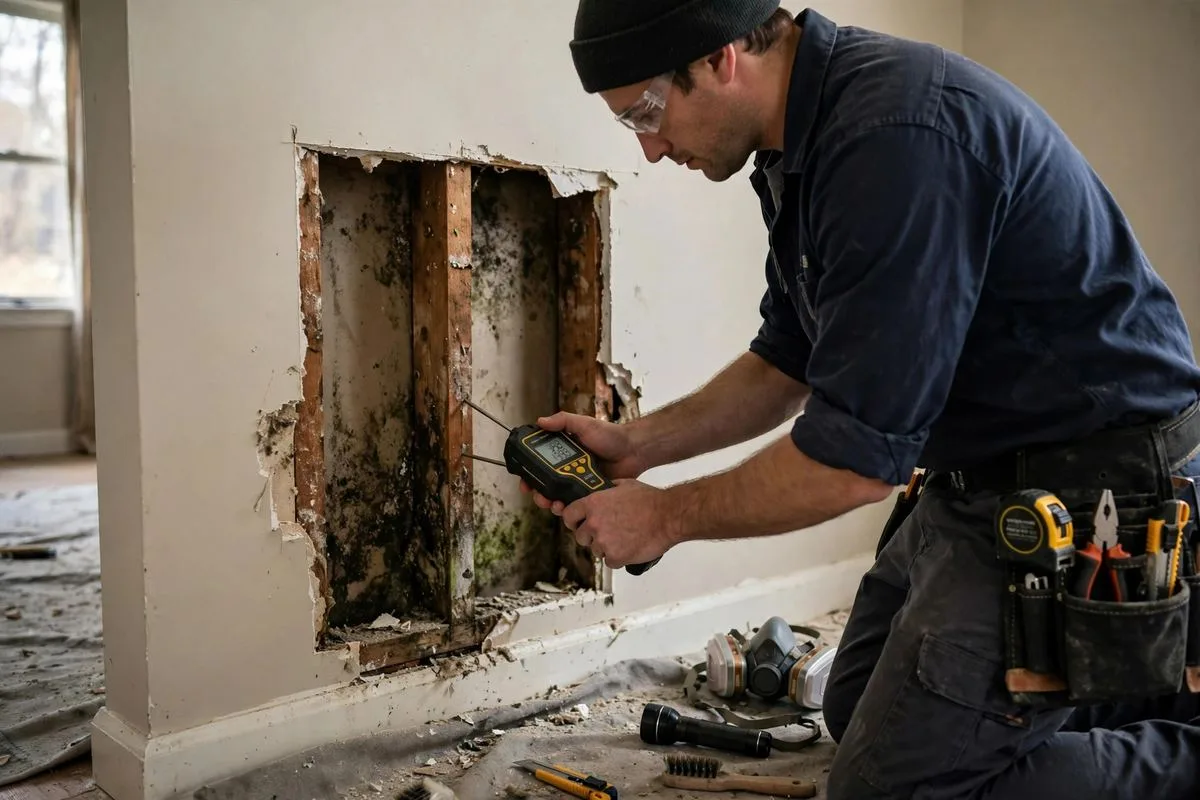
Hidden mold is the mold you cannot see — behind drywall, under flooring, above a ceiling, or inside a wall cavity — and it is the mold that causes the most trouble, because it grows for months before anyone notices. The smell gives it away first, or a stain, or symptoms that get worse at home. Finding it takes tools and method, not guesswork.
Mold Removal Experts LA is a referral service. We do not perform the work ourselves. We connect you with independent local mold providers who specialise in finding hidden mold, using moisture meters, thermal cameras, and inspection openings to locate growth without tearing a home apart. This page explains how hidden mold is detected and what happens once it is found.
One tip: photograph any stain or damp patch from the same spot each week, so the provider can see whether it is growing and how fast.
Where hidden mold grows in Los Angeles homes
The most common hiding places are inside wall cavities fed by a slow plumbing leak, under bathroom and kitchen floors where a leak has soaked the subfloor, above ceilings where a roof leak runs along a joist, and in attics and crawl spaces where ventilation is poor. LA's wood-framed construction hides all of these well: drywall, flooring, and ceilings cover the growth completely.
Hidden mold is also common after a water event that seemed minor at the time — a dishwasher overflow that was mopped up, a roof leak that was patched, a spill that dried on the surface. The surface dries, the material underneath stays wet, and the mold grows where no one looks.
Signs that mold is hiding somewhere
Hidden mold announces itself indirectly. One sign on its own may mean nothing; several together are a good reason to arrange an inspection:
- A musty smell with no visible source, stronger in one room or when the AC starts
- A stain, a bubble, or peeling paint on a wall or ceiling
- Flooring that feels soft, or a floor that cups or buckles in one area
- Baseboards that are warped or pulling away from the wall
- Symptoms that ease when you leave the house and return when you come back
- A room that feels damp, or condensation that keeps appearing in one place
How providers detect hidden mold
Providers use a sequence of tools rather than opening walls at random. A moisture meter maps which surfaces are damp and how far the dampness extends. A thermal camera shows cold, wet areas inside a wall or floor that the eye cannot see. A borescope camera, fed through a small hole, lets the provider look inside a cavity directly. Air or surface sampling may be used when the extent of growth is unclear or when laboratory confirmation is wanted.
The point of the sequence is to open as little as possible. A provider who maps first and opens second leaves you with a small patch to repair. A provider who opens walls by guesswork leaves you with a larger repair and the same uncertainty. Ask any provider how they locate hidden mold before agreeing to the work.
What happens after hidden mold is found
Once the growth is located, the job becomes a standard remediation: containment around the affected area, removal of the materials that cannot be cleaned, cleaning of hard surfaces, drying, and a check that the moisture source is fixed. The difference from a visible mold job is the repair afterwards — opening a wall or lifting flooring means rebuilding that section, and the provider should explain what the repair involves before the work starts.
In some cases the source is not in the room where the mold was found at all — a leak two rooms away, or a roof problem that runs along a joist before it drips. The provider's inspection should trace the moisture to its actual source, not just to the nearest stain.
What affects the cost
Hidden mold jobs are priced by what is found, and the scope is unknown until the detection work is done. A small patch inside one wall is a small job; growth spread through several cavities or under a whole floor is a larger one. The detection work itself — the inspection, the moisture mapping, and any sampling — is part of the quote, and the provider should explain what it covers before starting. No price can be quoted before an inspection. Our cost guide explains the factors and publishes reported market ranges from named sources.
After detection: what the remediation plan looks like
Detection is the first half of the job; the remediation plan is the second. Once the growth is located, the provider writes a scope: which areas are affected, which materials will be removed and which will be cleaned, how the work area will be contained, how the space will be dried, and how the result will be verified. That written scope is the document you use to compare quotes, to understand the price, and to check the work when it is done.
The plan should also name the moisture source and what will fix it, because the remediation is only as good as the source fix. If the source is a leak, the plan should say who repairs it — a plumber, a roofer, or the mold provider — and when. If the source is ventilation, the plan should say what changes. A plan that lists the removal work but says nothing about the source is incomplete, and you should ask the provider to complete it before agreeing to the work. The verification step — an independent check after the work — is part of the plan too, not an afterthought.
Related pages
How a referral works
- Tell us about the mold. Where it is, how large the area looks, and whether there has been a leak or flood.
- We connect you with independent local providers. They do the inspection, testing, removal or remediation — we do not perform the work ourselves.
- The provider contacts you. They arrange the visit, explain what they found, and agree the work with you directly.
Frequently asked questions
What is a thermal camera, and how does it find mold?
A thermal camera shows temperature differences across a surface. Wet areas inside a wall or floor are cooler than dry ones, so they show up on the camera. It does not see mold directly — it sees the dampness that lets mold grow, and the provider confirms the growth with a moisture meter or a small opening.
Can a moisture meter give false readings?
Yes. Metal, foil-backed insulation, and some building materials can distort readings. A careful provider interprets the meter alongside a thermal camera and a visual inspection, rather than trusting a single number.
Should I get air sampling for hidden mold?
Sampling helps when the extent of growth is unclear, or when you need laboratory confirmation for a dispute or a transaction. The provider can advise whether sampling is worth it for your situation — it is not needed for every job.
How much wall will the provider need to open?
Only the section the moisture mapping points to. Mapping first and opening second is the whole point of detection work — it keeps the repair small. A provider who opens walls by guesswork is not doing detection.
Can hidden mold be found without opening anything?
Sometimes. A moisture meter and thermal camera can locate dampness without opening a wall, and in some cases that is enough to confirm the problem. Often a small inspection opening is still needed to see the growth directly and judge its extent.
What if the provider finds nothing?
The report is still useful — it documents that the area was checked, with readings, and rules out the most likely sources. The smell or stain may have another cause, such as a drain problem or an HVAC issue, and the provider can advise on the next step.
Request a referral
Please note: online requests are not connected yet — the request form for this domain is still being set up. Your details are not sent when you submit this form. For the fastest response, please call (945) 422-7665.
Need mold help in Los Angeles?
Tell us where the mold is and how large the area looks. We will connect you with an independent local provider.
Request a referral Call (945) 422-7665
Mold Removal Experts LA is a referral service. We do not perform mold inspection, testing, or remediation. We connect you with independent local providers who do the work.