Commercial Mold Remediation in Los Angeles
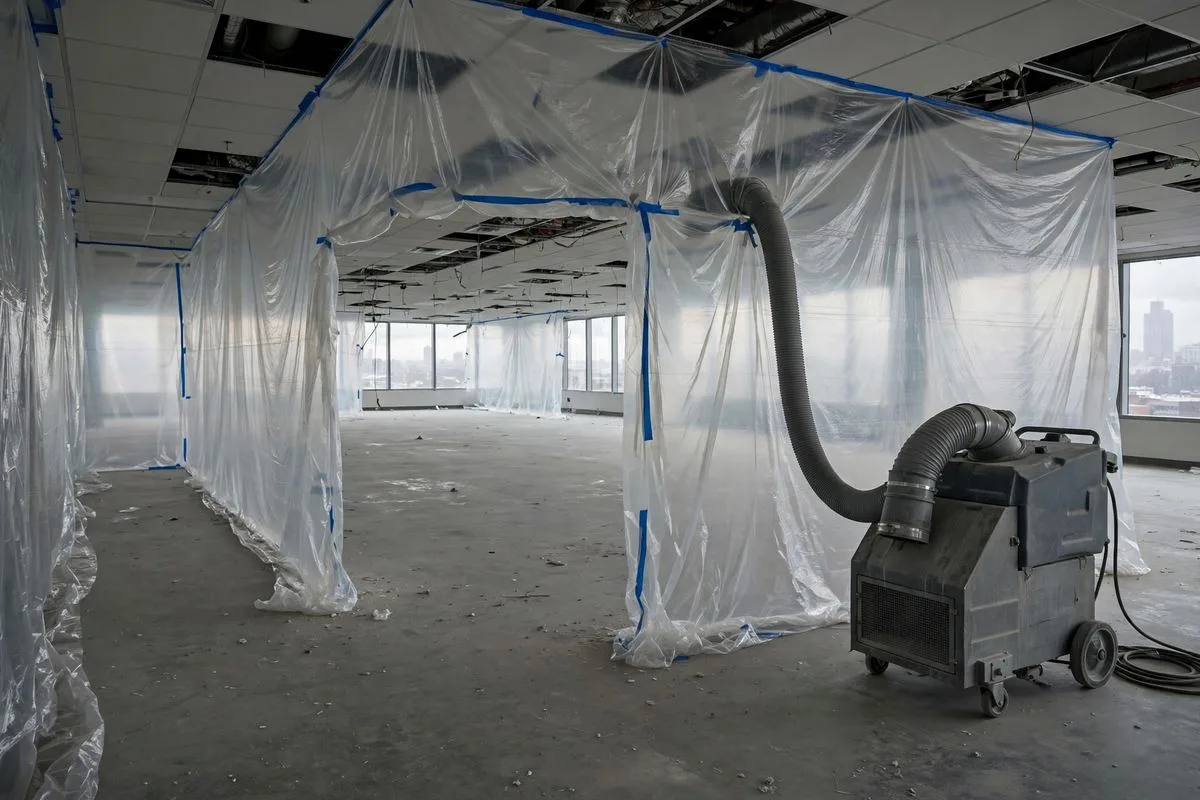
Commercial mold remediation in Los Angeles is the contained removal of mold in offices, retail spaces, restaurants, schools, healthcare facilities and multi-unit residential buildings, carried out by independent local providers. Commercial work differs from residential work in scale, in scheduling, in documentation, and in who is affected: employees, customers, tenants and residents, not only the owner. Mold Removal Experts LA does not perform commercial work itself. This site connects you with independent local providers, and the provider who takes your job performs the work and discusses the scope, scheduling and pricing directly with you.
A commercial mold problem is also a business problem. The growth has to be removed, but the building has to keep operating, or the interruption has to be planned and contained. Occupants have to be protected. Documentation has to satisfy insurers, building managers and, in multi-unit buildings, the residents. The provider who takes a commercial job plans for all of that, and the written scope reflects it.
Who we serve
Homeowners are one audience, but commercial mold work serves several others, and each has different needs. Property managers need a repeatable process they can use across many units, with clear communication and a single point of accountability for each job. Commercial owners and operators need work scheduled around tenants and operations, with minimal disruption to the business. Building managers for multi-unit and occupied buildings need work that protects residents who stay in place while the work happens in one unit or one area.
The referral network includes providers who work with each of these situations. When you request commercial help, describe the property type, the number of units or the size of the space, whether the building is occupied, and who needs to be kept informed. That information decides which provider is matched to the job, because a provider who handles single-family homes is not necessarily the provider for a multi-unit building with occupied units.
- Homeowners and residential property owners
- Property managers with many units and a need for a repeatable process
- Commercial owners and operators: offices, retail, restaurants
- Building managers for occupied and multi-unit buildings
- HOAs and multi-unit residential buildings
Occupied and multi-unit handling
Work in an occupied building is planned around the people in it. The contained area is sealed off, and the rest of the building continues to operate. Access is scheduled so tenants and employees are not disrupted more than necessary, and communication is planned in advance: who is told what, when, and by whom. In multi-unit buildings, a leak or growth in one unit often affects the units above, below or beside it, and the provider checks those units as part of the inspection.
Multi-unit work also raises the question of responsibility: which part of the problem belongs to the building, which to the unit owner, and which to the tenant. The provider's inspection and written scope describe the physical facts, and the building manager or HOA decides the responsibility question with that evidence. The provider does not decide it. The mold assessment page explains the documentation involved.
- Contained area sealed off; the rest of the building keeps operating
- Access scheduled around tenants and employees
- Communication planned in advance: who is told what, and when
- Neighboring units checked when a leak affects more than one unit
- The inspection describes the facts; responsibility is decided by the building
Commercial liability: occupant health, business interruption, duty to act
A commercial property owner has responsibilities that a homeowner does not. Occupants, employees and customers use the building every day, and a mold problem that is left unaddressed exposes them to the growth and exposes the owner to complaints, claims and regulatory attention. The duty to act is not only a matter of good management. In California, a landlord's duty to maintain a habitable building is set out in the Civil Code, and visible mold that endangers health is a substandard building condition under the Health and Safety Code. This is general information, not legal advice, and the specifics of any situation belong to a lawyer.
Business interruption is the second liability. A mold problem that closes a restaurant, an office floor or a retail space costs revenue every day it continues, and the longer the moisture source goes unfixed, the larger the affected area and the longer the interruption. Acting quickly is therefore a commercial decision as well as a health decision: the cost of delay is measured in disruption as well as in remediation. The third liability is documentation. Insurers, building managers and regulators all ask for records, and a job that is not documented is a job that cannot be defended. The written scope, the moisture readings, the laboratory results and the clearance report are the record.
- Occupants, employees and customers use the building every day
- California law sets out a landlord's duty to maintain a habitable building
- Business interruption costs revenue every day the problem continues
- Delay increases both the affected area and the disruption
- Documentation is the record insurers and managers ask for
The commercial remediation process
Commercial remediation follows the same IICRC S520 process as residential work, scaled to the building. Assessment comes first: inspection, moisture mapping, and a written scope that covers the affected areas, the moisture source, and the scheduling constraints. Containment is planned around the building's use, with the work area sealed off and filtered air equipment running. Affected materials are removed in sealed bags. The structure is cleaned and dried until moisture readings show it is dry. Independent clearance testing verifies the result.
The differences are in the planning. A commercial scope includes the hours of work, the access routes, the protection of unaffected areas, and the communication plan. It states who is responsible for notifying occupants and who the point of contact is during the job. It also states whether rebuilding is included or left to a separate contractor. All of that should be in writing before work begins.
- Assessment, moisture mapping and a written scope
- Containment planned around the building's use
- Hours of work, access routes and occupant protection in the scope
- Communication plan and a named point of contact
- Independent clearance testing verifies the result
Documentation for insurers and building managers
Commercial mold work generates documentation that residential work often does not need. Insurers ask for the inspection report, the moisture readings, the scope of work, photographs of the affected areas, and the clearance report after the job. Building managers ask for the same records for their files, and for the communication log showing who was notified and when. Property managers with many units need the same documentation in a repeatable format across jobs.
The provider who takes a commercial job supplies that documentation as part of the service, and the scope should state what will be supplied and when. If a claim is involved, the documentation is the practical bridge between the job and the claim: it shows what was found, what was done, and what the result was. The insurance guide on this site explains the distinctions insurers draw, in general terms, and the documentation providers supply.
- Inspection report, moisture readings and scope of work
- Photographs of the affected areas
- Clearance report after the job
- Communication log showing who was notified and when
- Repeatable format for property managers with many units
What affects the cost of commercial mold remediation
No price is quoted on this site, because commercial pricing depends on the size of the affected area, the number of rooms or units, the type of building, the scheduling constraints, and the documentation required. Only the provider who has seen the building can quote it. The cost guide explains the factors that move pricing for mold work generally. When you request commercial help, ask whether the quote includes after-hours work, occupant protection, and the documentation package, or whether those are separate.
- Size of the affected area and number of rooms or units
- Type of building and scheduling constraints
- Occupant protection and after-hours work
- Documentation package for insurers and managers
- Whether rebuilding is included or a separate contractor's job
Related pages
How a referral works
- Tell us about the mold. Where it is, how large the area looks, and whether there has been a leak or flood.
- We connect you with independent local providers. They do the inspection, testing, removal or remediation — we do not perform the work ourselves.
- The provider contacts you. They arrange the visit, explain what they found, and agree the work with you directly.
Frequently asked questions
How is commercial mold remediation different from residential?
It is larger in scale, and it has to be planned around occupants, tenants and operations. The scope includes hours of work, access routes, occupant protection and a communication plan, and the documentation is more extensive: insurers and building managers need the inspection report, moisture readings, photographs and clearance report.
Can mold remediation happen while the building is occupied?
Often, yes, when the work area can be contained and sealed off from the rest of the building. The provider plans the containment, the access routes and the schedule around the occupants. In some cases, part of the building must be closed during the work. The provider advises what is needed for your specific building.
What documentation does a commercial mold job produce?
The inspection report, the moisture readings, the written scope of work, photographs of the affected areas, and the clearance report after the job. Property managers also receive a communication log showing who was notified and when. The scope should state what documentation will be supplied.
Who is responsible for mold in a multi-unit building?
It depends on the building, the lease or HOA documents, and where the moisture source is. The provider's inspection describes the physical facts: where the growth is and what caused it. The building manager, HOA or landlord decides the responsibility question with that evidence. The specifics of any situation belong to a lawyer.
How long does commercial mold remediation take?
It depends on the size of the affected area, the number of units or rooms, and the scheduling constraints. A small contained job can take a day or two; a larger job across several units or floors takes longer, including drying time and independent clearance testing. The provider who scopes the job can give a realistic timeframe after seeing the building.
Does commercial mold remediation include rebuilding?
Not always. Some providers rebuild what they removed, and others leave the area clean, dry and ready for a separate contractor. The written scope of work should state clearly whether rebuilding is included, and the scheduling should reflect it.
Request a referral
Please note: online requests are not connected yet — the request form for this domain is still being set up. Your details are not sent when you submit this form. For the fastest response, please call (945) 422-7665.
Need mold help in Los Angeles?
Tell us where the mold is and how large the area looks. We will connect you with an independent local provider.
Request a referral Call (945) 422-7665
Mold Removal Experts LA is a referral service. We do not perform mold inspection, testing, or remediation. We connect you with independent local providers who do the work.