Mold Removal vs Mold Remediation
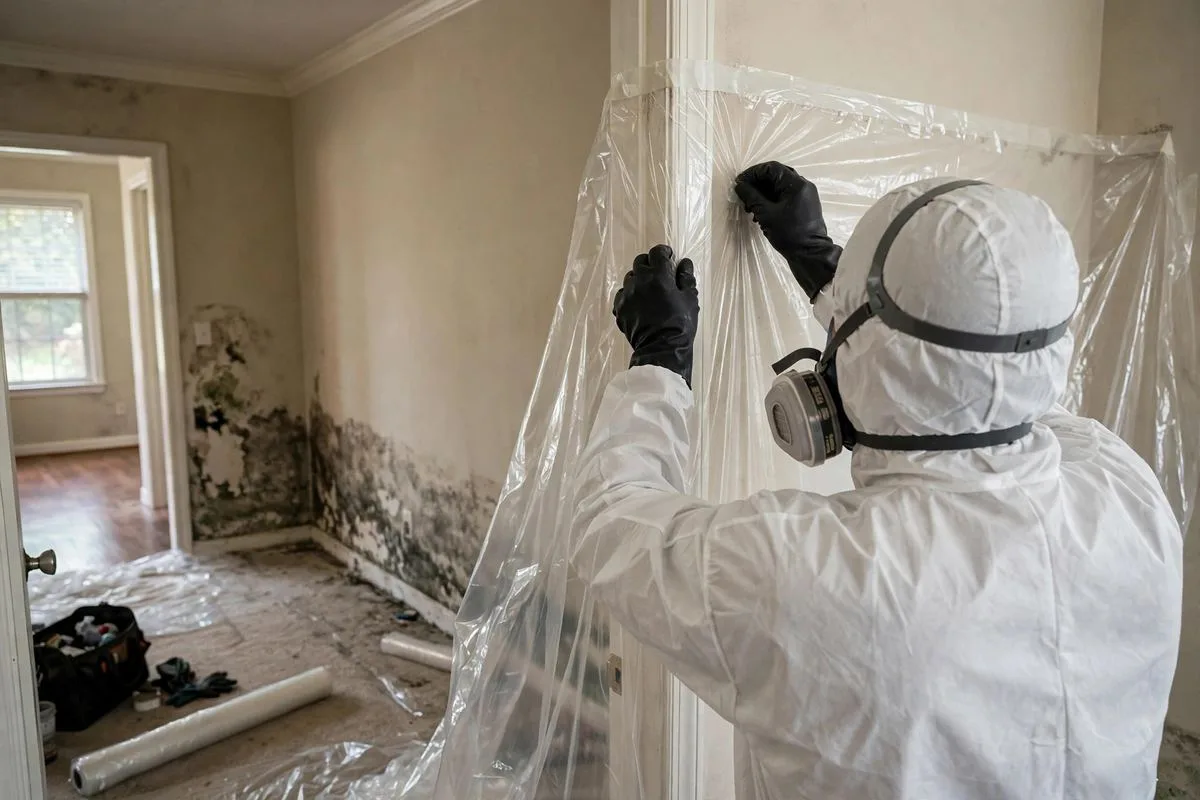
Mold removal and mold remediation are used as synonyms so often that most people assume they are the same thing. They are related, but they are not the same. Mold removal is one part of the job — taking the mold out. Mold remediation is the whole job — finding the moisture source, containing the area, removing the mold, drying the space, and verifying the result. Knowing the difference matters, because a quote for one is not a quote for the other.
Mold Removal Experts LA is a referral service. We do not perform the work ourselves. We connect you with independent local mold providers who carry out both removal and remediation, and who should be clear about which one they are quoting. This guide explains the terms, the process, and the related words — mold treatment, mold abatement, mold mitigation — so you know what you are buying.
One last point: the two terms also appear in insurance paperwork, and the distinction matters there too. An insurer may cover remediation — the full process, including drying and verification — differently from removal alone, because the scope is different. The insurance guide explains how that distinction plays out in a claim.
What mold removal means
Mold removal is the physical act of taking mold out of a building. It means removing affected materials that cannot be cleaned — such as saturated drywall or carpet — and cleaning the surfaces that can be cleaned. It is the most visible part of the job, and it is the part most people picture when they think of mold work.
Removal on its own is a limited service. It takes the growth out, but it does not find the moisture source, it does not dry the space, and it does not verify the result. A provider who only removes the visible mold and leaves the leak in place has done removal, not remediation — and the mold will usually return.
What mold remediation means
Mold remediation is the full process, carried out to the professional standard — the IICRC S520 standard for professional mold remediation. It has five phases: assessment and a written scope, containment and HEPA air filtration, removal and cleaning, drying, and independent verification that the area is clear. Removal is the middle phase, not the whole job.
The difference shows in the result. A remediation job ends with a dry space, a fixed moisture source, and a verification that the area is clear. A removal-only job ends when the visible mold is gone, with no answer to why it grew or whether it will come back. When you compare quotes, ask whether the quote covers remediation or removal only — the price difference reflects a real difference in scope.
Mold treatment, abatement, and mitigation: the synonyms
Several other terms appear in search results and in provider marketing, and they mostly describe the same work. Mold treatment is a general word for any process that addresses mold, and it is used interchangeably with removal and remediation — it has no separate technical meaning. Mold abatement is the term used in some regulations and in older usage, and it generally means the same as remediation: removing the mold and controlling the conditions that let it grow. Mold mitigation is a broader word that covers reducing the risk and the damage — stopping the water, drying the space, and preventing regrowth — and it overlaps with both removal and remediation.
None of these terms is a separate service you need to buy in addition to remediation. They are different words for the same family of work, and a provider who uses one term rather than another is usually describing the same job. What matters is the scope in the quote, not the label on it.
Which one does your job need?
A small patch of surface mold on a hard, non-porous surface — tile, grout, metal — can often be handled as a cleaning job, and does not need full remediation. Anything larger, anything inside a wall or under flooring, anything that has been growing for a while, or anything where the moisture source is unknown needs remediation, not just removal. The inspection is what decides: a provider who inspects, maps the moisture, and writes a scope is doing remediation; a provider who quotes from a photograph is guessing.
The other factor is the moisture source. If the source is fixed — a leak repaired, a drain cleared, ventilation improved — then removal may be enough for a small job. If the source is not fixed, no amount of removal will hold. That is the question to ask any provider: what is feeding the mold, and what are you doing about it.
The conflict-of-interest point: who inspects, who remediates, who verifies
There is one more distinction that matters, and it is about people rather than terms. California has no law separating assessment and remediation the way Texas does, but the professional standard is the same everywhere: the provider who inspects should not be the one who certifies their own remediation work. The inspection produces a written scope; the remediation follows that scope; and an independent provider verifies the result afterwards. That separation is the standard our referral model is built around — inspection, remediation, and clearance from separate independent providers — and it is the reason a referral site can be more trustworthy than a single company that does all three and marks its own homework.
A worked example: the same job, two quotes
Imagine a bathroom with mold behind the shower wall. One provider quotes for removal only: cut out the affected drywall, clean the framing, and leave the wall open. The price is lower. Another provider quotes for remediation: inspect and map the moisture, contain the area, remove the affected drywall and insulation, clean and dry the framing, fix the shower pan leak that caused it, and verify the result with an independent check. The price is higher — and it is the only one of the two that solves the problem.
The difference is not the price. It is the scope. The first quote leaves the leak in place, leaves the framing damp, and leaves no verification — so the mold returns, and the second job costs more than the first. The second quote costs more up front and ends the problem. When you compare quotes, compare the scopes line by line, not the totals. A quote that does not mention containment, drying, the moisture source, or verification is a removal quote, whatever it is called.
Questions to ask before you hire
The terms on this page are useful, but the questions are what protect you. Before you hire any provider, ask: will you inspect before quoting, and will the findings be in writing? What is feeding the mold, and what will fix it? How will you contain the work, and how will you dry the area? Who wrote the remediation protocol, and who will verify the result? Is the quote for removal or for remediation, and does it include rebuilding?
A provider who answers all of those plainly, in writing, is a provider worth hiring. A provider who cannot answer them, or who quotes from a photograph without inspecting, is not. The referral model exists so that you can ask these questions of an independent provider — and so that the answers come from someone with no financial stake in the remediation work that follows.
Related pages
How a referral works
- Tell us about the mold. Where it is, how large the area looks, and whether there has been a leak or flood.
- We connect you with independent local providers. They do the inspection, testing, removal or remediation — we do not perform the work ourselves.
- The provider contacts you. They arrange the visit, explain what they found, and agree the work with you directly.
Frequently asked questions
What does IICRC S520 cover?
The IICRC S520 is the professional standard for mold remediation. It sets out how remediation should be done — assessment, containment, removal, cleaning, drying, and verification — and it is the standard providers are expected to follow. It is an industry standard, not a law, but it is the benchmark a careful provider works to.
What is a remediation protocol?
A written scope of work produced by an inspection, describing what is to be removed, cleaned, and dried, and how the result will be verified. It is the document that lets you compare quotes from different providers on the same defined work, and it is what the verification provider checks against afterwards.
Is mold remediation regulated in California?
California does not license mold inspectors or remediators as a separate profession. That makes vetting more important, not less: ask for third-party certification, an accredited laboratory for testing, results in writing, and an independent clearance check. A provider who cannot show those things is asking you to trust a claim with no evidence behind it.
What is clearance testing?
Independent testing after remediation to confirm the area is clear — usually air or surface samples compared against the pre-remediation results or an outdoor baseline. It is done by a provider separate from the one who remediated, and it is the step that closes the job.
Can one company do both inspection and remediation?
California has no law forbidding it, unlike Texas. But the professional standard says the inspector should not certify their own remediation work, and the referral model exists to enforce that separation structurally — inspection, remediation, and clearance from separate independent providers.
What is HEPA filtration?
Filtration through a high-efficiency particulate air filter, which captures very fine particles including mold spores. HEPA-filtered air machines are used inside containment during remediation and for cleaning afterwards, and they are part of what separates professional remediation from a general cleanup.
Request a referral
Please note: online requests are not connected yet — the request form for this domain is still being set up. Your details are not sent when you submit this form. For the fastest response, please call (945) 422-7665.
Need mold help in Los Angeles?
Tell us where the mold is and how large the area looks. We will connect you with an independent local provider.
Request a referral Call (945) 422-7665
Mold Removal Experts LA is a referral service. We do not perform mold inspection, testing, or remediation. We connect you with independent local providers who do the work.